AI Prompts for Startup Pitch Decks
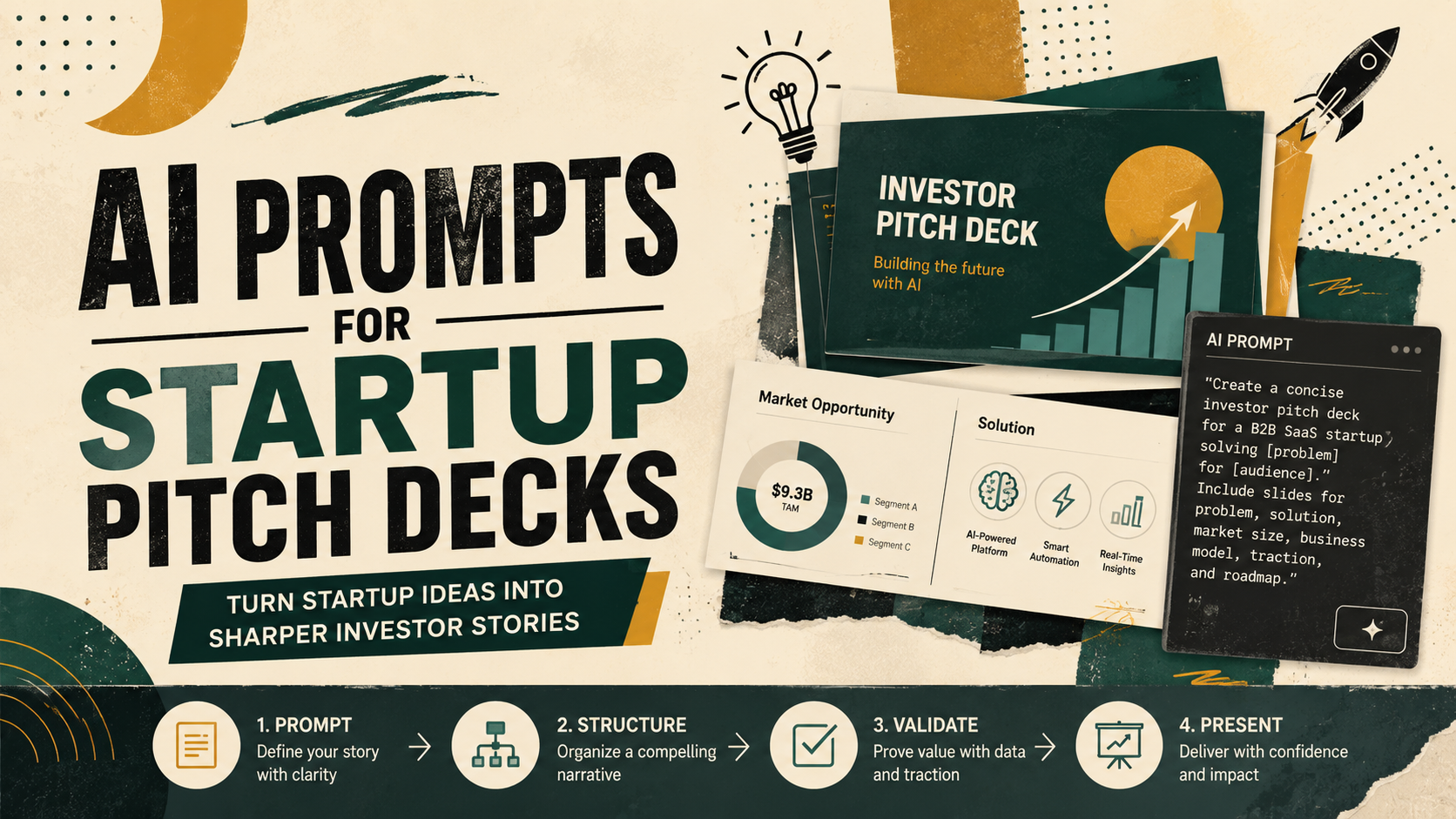
Founders often know their startup better than anyone, yet still struggle to turn that knowledge into a concise investor story. The problem is not a lack of information. It is deciding what belongs in the deck, what should be simplified, and what proof investors need before they believe the opportunity is worth a meeting.
That is why a strong startup pitch deck prompt matters. Asking AI to “make a pitch deck for my startup” may produce a fast draft, but it rarely produces a persuasive investment narrative. A better AI pitch deck prompt gives the model context, priorities, evidence, and constraints so the output supports the way investors evaluate a company.
Used well, AI prompts can help founders organize their thinking, pressure-test the story, and create a clearer first draft. Used carelessly, they can create generic slides that sound polished but say very little.
Why Startup Pitch Deck Prompts Need More Than a Topic
A pitch deck is not a company brochure. It is an investor-facing argument about why this company, this market, this team, and this moment deserve capital. Generic AI tools can help with speed, but the challenge begins when the output lacks strategic judgment.
Weak prompts often lead to slides that are:
- Too broad, with claims any startup could make
- Too wordy, leaving no clear investor takeaway
- Too optimistic, with unsupported market or traction claims
- Too disconnected, where each slide feels like a separate summary
- Too visual-first, without a clear business logic underneath
A useful investor presentation prompt should tell AI what the company does, who the investors are, what stage the business is in, what proof already exists, and what the deck needs to achieve. The more precise the input, the more likely the output will reflect a focused fundraising narrative rather than a generic startup template.
The Core Framework for a Strong AI Pitch Deck Prompt
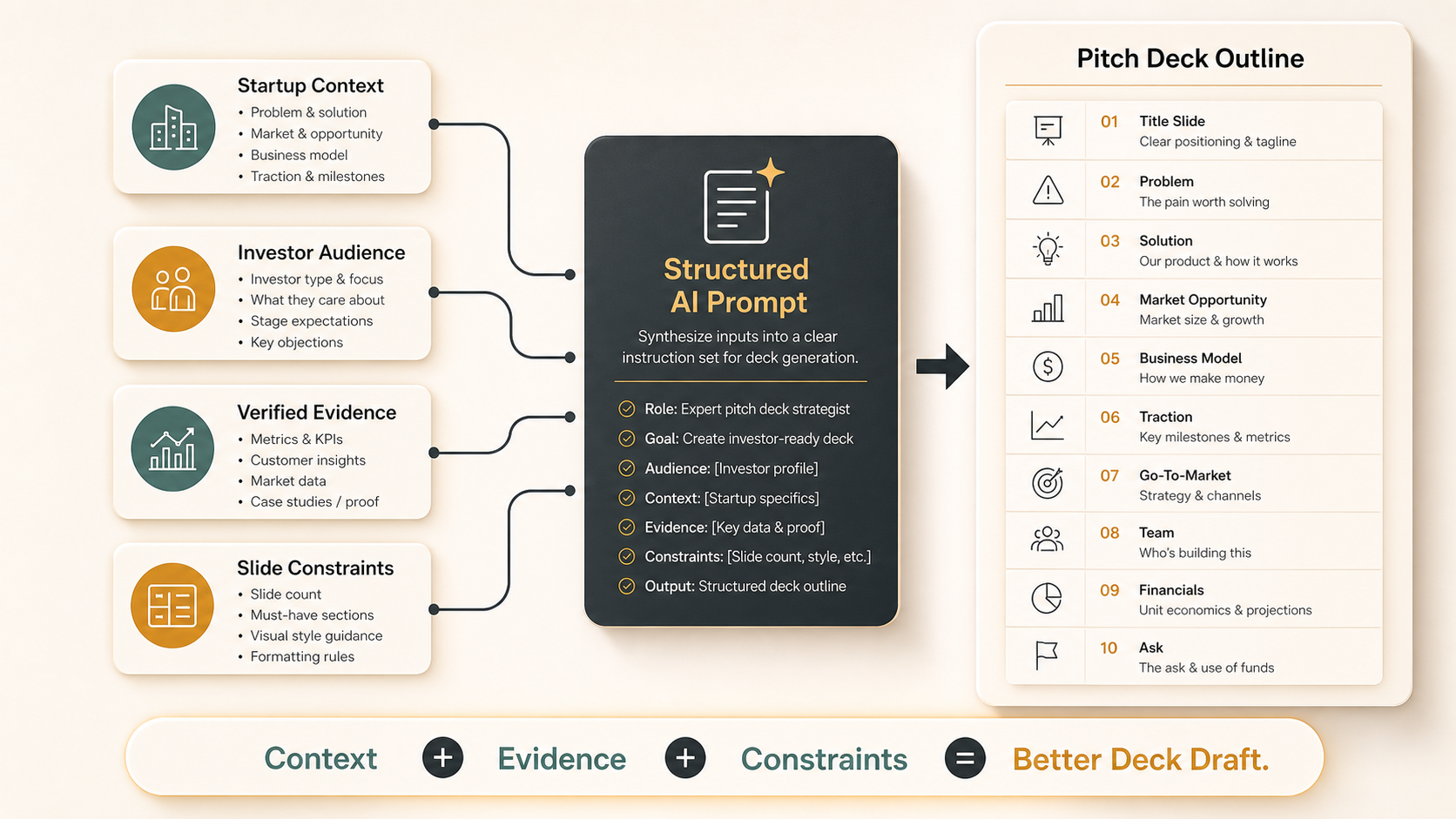
Before writing individual slide prompts, start with a reusable structure. This gives AI the business context it needs before it creates an outline or draft.
A strong AI pitch deck prompt should include the company category, customer segment, startup stage, fundraising objective, investor audience, current proof points, competitive context, desired tone, and slide constraints. It should also specify whether the deck is for a cold send, an in-person meeting, a demo day, or a follow-up conversation.
The best prompts do not ask AI to invent missing information. They ask AI to structure what is known, identify gaps, and suggest where the founder should provide stronger evidence. This is especially important for traction, financials, market sizing, and customer proof.
A Master Startup Pitch Deck Prompt You Can Adapt
Use this master startup pitch deck prompt as a starting point. Replace the bracketed sections with your real information.
```text Act as an investor presentation strategist. Help me create a startup pitch deck for [company name], a [one-sentence company description] serving [target customer].
Company stage: [pre-seed / seed / Series A / growth] Fundraising goal: [amount and intended use of funds] Target investors: [angel investors / seed funds / SaaS investors / climate investors / strategic investors] Audience knowledge level: [new to category / familiar with category / expert] Deck use case: [cold email deck / live meeting deck / demo day deck / follow-up deck]
Known proof points:
- Traction: [revenue, users, pilots, retention, growth rate, partnerships, waitlist, or “not yet available”]
- Market evidence: [market size source or internal estimate]
- Product proof: [demo, prototype, launched product, customer usage]
- Team strengths: [relevant founder experience]
- Differentiation: [why now, why better, why defensible]
Create a structured pitch deck outline first. Include the recommended slide order, the purpose of each slide, and the key investor question each slide should answer. Do not invent metrics or claims. Flag any missing information I should provide before drafting slide copy. After the outline, write concise slide headlines and supporting points in a confident, investor-ready tone. ```
This prompt works because it asks for structure before slide writing. That sequence helps prevent AI from jumping into decorative content before the investment logic is clear.
Section-by-Section AI Prompts for Investor Presentations
For the problem slide, ask AI to connect the customer pain to business urgency: “Draft a problem slide for [target customer] experiencing [specific pain]. Make the problem measurable, urgent, and relevant to investors. Avoid vague statements and include three evidence-based pain points using only the facts I provide.”
For the market slide, use an investor presentation prompt that separates market size from market timing: “Create a market slide explaining the size, growth, and timing of the opportunity in [category]. Distinguish TAM, SAM, and initial beachhead market. Do not invent numbers; use placeholders where data is missing.”
For the solution slide, ask AI to explain the product in plain business language: “Write a solution slide for [product]. Show how it solves the problem differently from current alternatives. Keep the message simple enough for a non-technical investor to understand.”
For the product slide, focus on workflow and value: “Create a product slide that explains the user journey, core features, and business outcome. Prioritize what the product enables over a list of features.”
For the traction slide, be strict about accuracy: “Draft a traction slide using only these metrics: [insert metrics]. Organize the evidence into customer demand, usage, revenue, retention, or partnerships. If the traction is early, frame it honestly without exaggeration.”
For the business model slide, ask for clarity: “Explain how [company] makes money, including pricing, buyer, sales motion, gross margin assumptions if available, and expansion potential. Keep the slide concise and investor-facing.”
For go-to-market, push AI beyond buzzwords: “Create a go-to-market slide for [customer segment]. Include acquisition channels, sales motion, first market focus, and why this path is realistic for our stage.”
For competition, avoid shallow grids: “Draft a competition slide that compares current alternatives based on customer decision criteria. Show our differentiation without dismissing competitors or making unsupported claims.”
For team, connect experience to execution: “Write a team slide showing why this team is qualified to solve this problem now. Emphasize relevant domain, technical, sales, product, or operating experience.”
For financials and the fundraising ask, keep the logic grounded: “Create a financials and ask slide using these assumptions: [insert assumptions]. Show how the funding will be used and what milestones it should help achieve. Flag any assumptions that need validation.”
Prompt Quality Checklist for Pitch Decks
| Prompt Standard | Weak Prompt Behavior | Stronger Prompt Behavior |
| Business context | Describes only the startup idea | Includes stage, audience, and funding goal |
| Evidence | Lets AI create claims | Provides verified metrics and asks AI to flag gaps |
| Investor relevance | Summarizes company features | Answers investor decision questions |
| Narrative flow | Generates disconnected slides | Builds a logical investment argument |
| Slide discipline | Requests long explanations | Sets concise headlines and slide limits |
The goal is not to make prompts longer for the sake of detail. The goal is to give AI the right context so every slide has a clear job.
Where AI Prompts Still Need Human Judgment
AI prompts can improve speed and structure, but founders should not outsource judgment. Investor decks require choices: which customer pain matters most, which metric proves momentum, which market segment should come first, and which part of the story is credible today.
Be especially careful with market sizing, revenue projections, customer quotes, and competitive differentiation. AI can make these sections sound confident even when the underlying evidence is weak. If a number is uncertain, label it as an estimate. If traction is early, show learning velocity, pipeline quality, user engagement, or pilot evidence instead of inflating results.
The strongest pitch decks are not the ones with the most dramatic language. They are the ones where the claims, proof, and fundraising objective align.
How Pi Helps Turn Pitch Deck Prompts into Business-Ready Slides
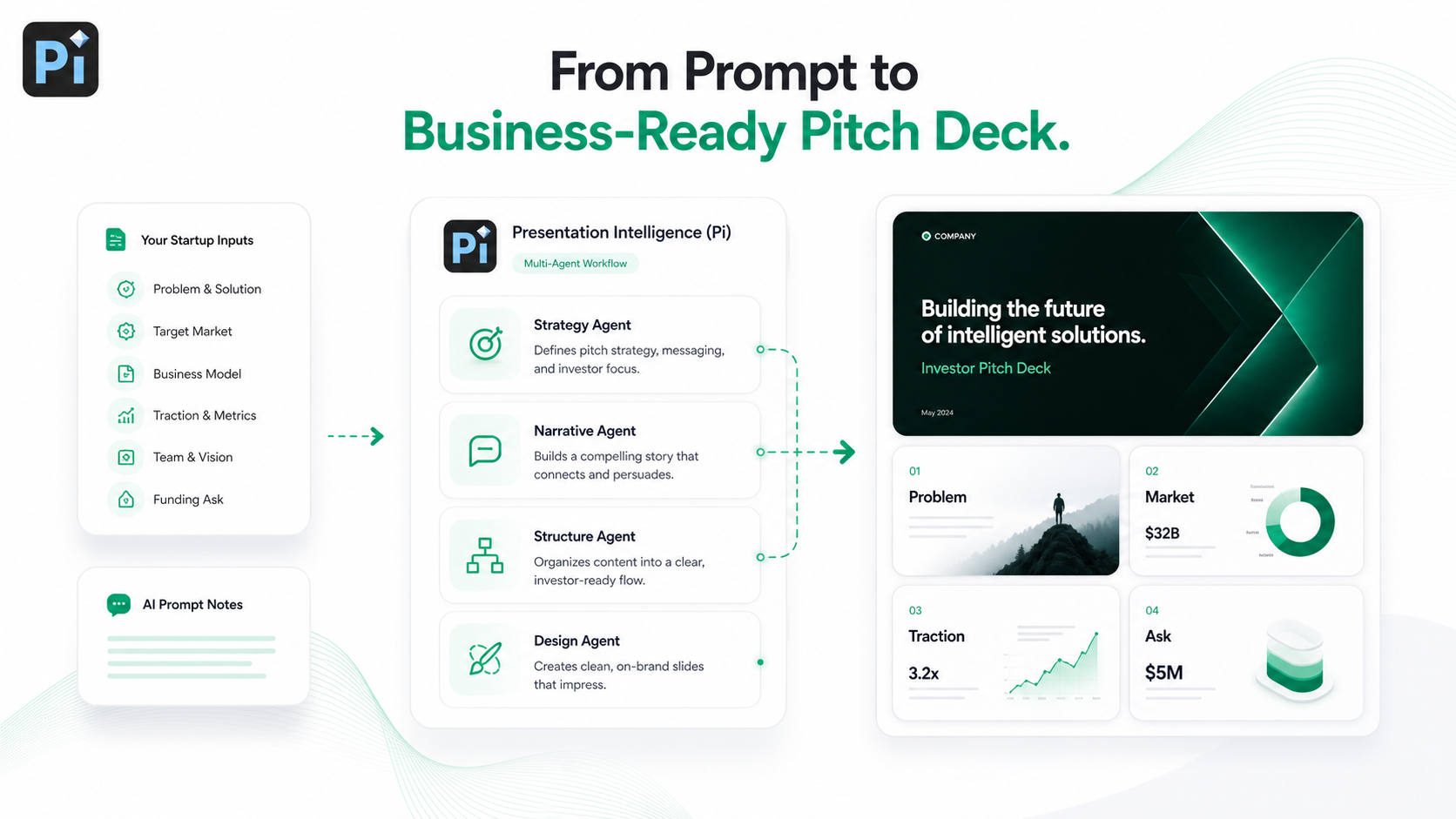
AI prompts are useful for drafting the story, but high-stakes pitch decks need more than text generation. Pi, short for Presentation Intelligence, is built for professional presentation workflows where structure, business logic, and visual quality all matter.
1. Business Logic Comes Before Slide Styling
Pi helps founders move from raw startup information to a more coherent investor narrative. Instead of treating the deck as a sequence of isolated slides, Pi supports the logic behind the presentation: what the audience needs to understand, what proof should appear first, and how each section supports the fundraising ask.
2. Multi-Agent AI Supports Deeper Presentation Workflows
A pitch deck involves strategy, writing, structure, and design. Pi’s Multi-Agent AI approach is designed to support these layers together, helping transform startup inputs into a more complete business presentation workflow rather than a simple text-to-slide draft.
3. Premium Visual Quality Helps the Story Feel Credible
Investors do not fund a company because the slides look beautiful, but visual quality affects credibility and comprehension. Pi helps turn structured content into business-grade slides with professional layouts, clear hierarchy, and premium aesthetics suitable for pitch decks, executive presentations, and other high-stakes settings.
A Practical Workflow for Building Your Pitch Deck with AI
Start by gathering your real inputs: customer pain, product description, market evidence, traction metrics, pricing, team background, competitive landscape, and fundraising plan. Then use the master AI pitch deck prompt to create the outline before asking for slide copy.
Next, refine each section with targeted prompts. Treat AI output as a strategic draft, not a final answer. Remove unsupported claims, tighten headlines, and replace generic language with specific evidence. Once the narrative is clear, use Pi to turn the structured story into a polished investor presentation with stronger business logic and professional visual execution.
The best workflow is not “prompt once and present.” It is gather, prompt, refine, verify, design, and rehearse.
Frequently Asked Questions (FAQ)
Q: What should I include in a startup pitch deck prompt? A: Include your company description, startup stage, target investors, fundraising goal, audience knowledge level, key proof points, desired tone, and required sections. The more specific your input, the less generic the AI output will be.
Q: Can AI create an investor-ready pitch deck? A: AI can create a strong first draft and help structure the narrative, but founders must verify facts, sharpen positioning, and adjust the story for real investors. Tools like Pi help turn structured inputs into more professional, business-ready slides.
Q: How do I avoid generic AI pitch deck results? A: Avoid prompts that only describe the topic. Add customer details, metrics, market focus, investor type, slide constraints, and proof points. Ask AI to create an outline first and to flag missing evidence instead of inventing claims.
Q: What is the most important AI pitch deck prompt? A: The master prompt is the most important because it defines the context for the whole deck. Section-specific prompts are useful, but the overall narrative depends on clear company context, fundraising objective, investor audience, and verified proof.