Claude Opus 5: How Frontier AI Is Changing Complex Knowledge Work
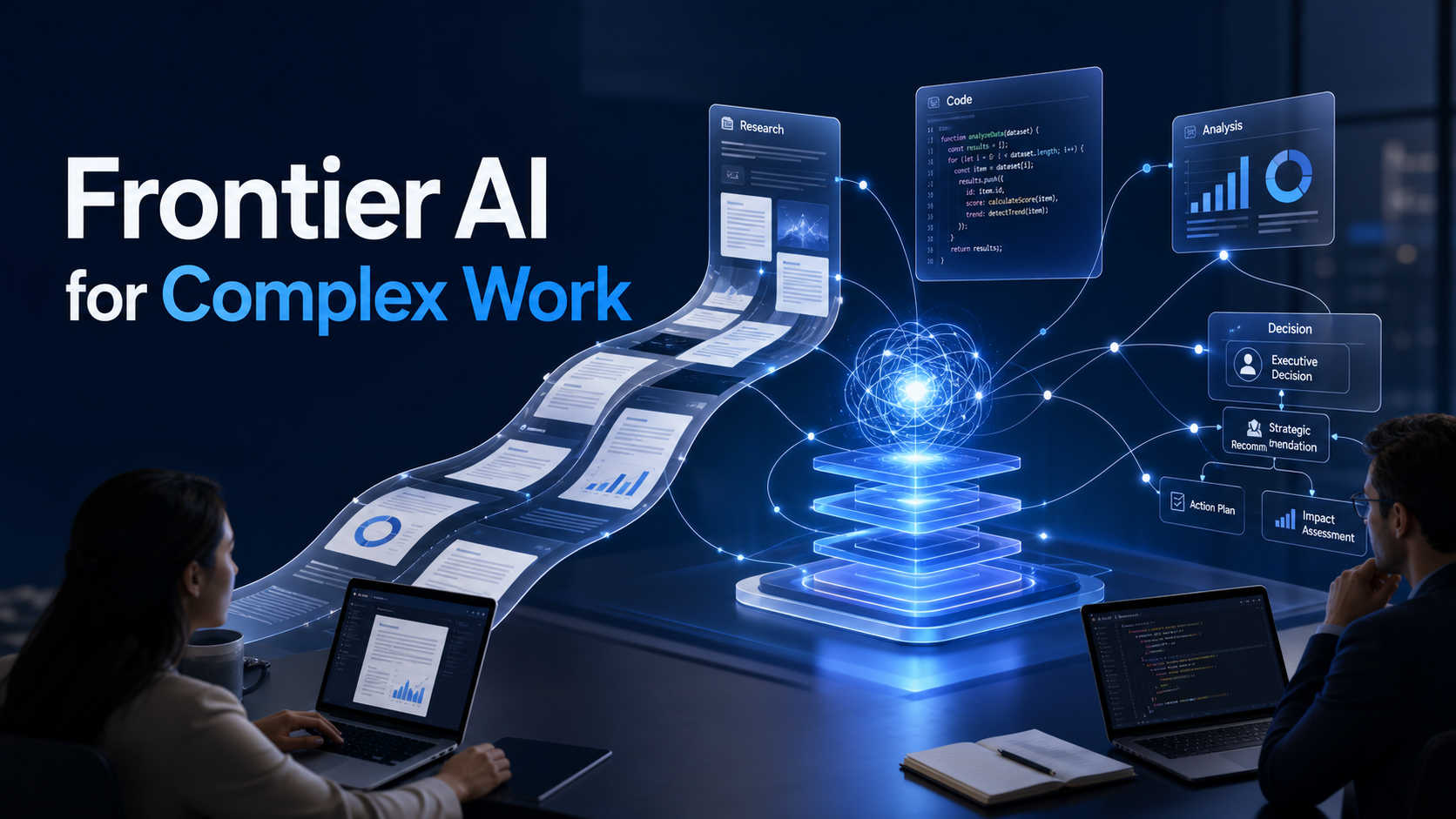
AI is moving beyond quick answers, simple summaries, and isolated writing tasks. For many professionals, the bigger shift is toward systems that can support complex knowledge work: reading large bodies of material, reasoning across competing inputs, assisting technical analysis, and helping teams move from information to decisions.
That is why Claude Opus 5 is attracting attention. Even if details around a Claude Opus 5 release are uncertain or unconfirmed, the interest reflects a real market need. Professionals are asking whether a frontier AI model can support research, coding, strategy, legal review, financial analysis, and document-heavy projects with more continuity and depth.
The question is not whether AI will replace knowledge workers. It is whether stronger models can help skilled teams work through complexity faster while preserving judgment, verification, and clear communication.
Why Claude Opus 5 Is Getting Attention
Search interest around Anthropic Claude Opus 5 reflects expectations for the next stage of high-end AI systems. Users are looking for stronger reasoning, better long-context performance, deeper coding support, and more reliable help with research-intensive workflows.
Because confirmed details may not be available, it is important to separate expectation from fact. When people discuss Claude Opus 5, they are often describing what a future Opus-level model could represent: a more capable reasoning layer for tasks that require memory, synthesis, and multi-step analysis.
For business and technical teams, the appeal is practical. A stronger AI coding model could help engineers understand unfamiliar codebases, propose refactors, debug issues, and generate implementation plans. Better AI research tools could help analysts compare sources, summarize reports, identify contradictions, and prepare briefs. Improved context handling could make it easier to work across transcripts, documents, notes, and data extracts without constantly fragmenting the task.
What Complex Knowledge Work Requires
Complex knowledge work is not just “hard work with documents.” It involves ambiguity, incomplete information, competing priorities, and the need to communicate conclusions clearly. A market research project may combine customer interviews, competitor notes, sales feedback, and industry reports. A legal review may involve clauses, precedent, risk interpretation, and stakeholder concerns. A software architecture plan may require technical constraints, business goals, cost tradeoffs, and implementation sequencing.
These tasks are difficult because they combine information processing with judgment. The professional must decide what matters, what is credible, what is missing, and how the final recommendation should be framed for a specific audience.
That is where frontier AI becomes useful. A model does not need to own the decision to reduce the burden of reading, comparing, drafting, structuring, and testing ideas. For teams under pressure, that support can be valuable if the output is treated as a working layer rather than a final authority.
Where a Frontier AI Model Could Help Most
A frontier AI model such as Claude Opus 5 could be especially useful in workflows where the challenge is not a single prompt, but a chain of reasoning. Instead of asking for one answer, professionals may use AI to explore assumptions, compare evidence, draft alternatives, and refine a recommendation over time.
In research, the model could summarize large documents, map themes across sources, and highlight disagreement. In strategy work, it could generate scenario outlines, evaluate tradeoffs, and help draft executive-ready reasoning. In software engineering, it could explain code, assist with tests, suggest implementation paths, or document technical decisions.
The strongest use cases are collaborative. The human sets the goal, supplies context, checks the evidence, and decides the direction. The AI accelerates intermediate work: reading, organizing, rewriting, comparing, and producing first-pass analysis.
| Capability | Frontier AI Model | Pi |
| Research synthesis | Analyzes source material | Turns findings into presentation flow |
| Coding support | Assists with code reasoning | Communicates technical plans clearly |
| Long document review | Maintains broader context | Structures takeaways for stakeholders |
| Business communication | Drafts analysis and narratives | Builds professional presentation outputs |
| Decision support | Explores options and assumptions | Frames recommendations in deck format |
The Importance of Long Context AI
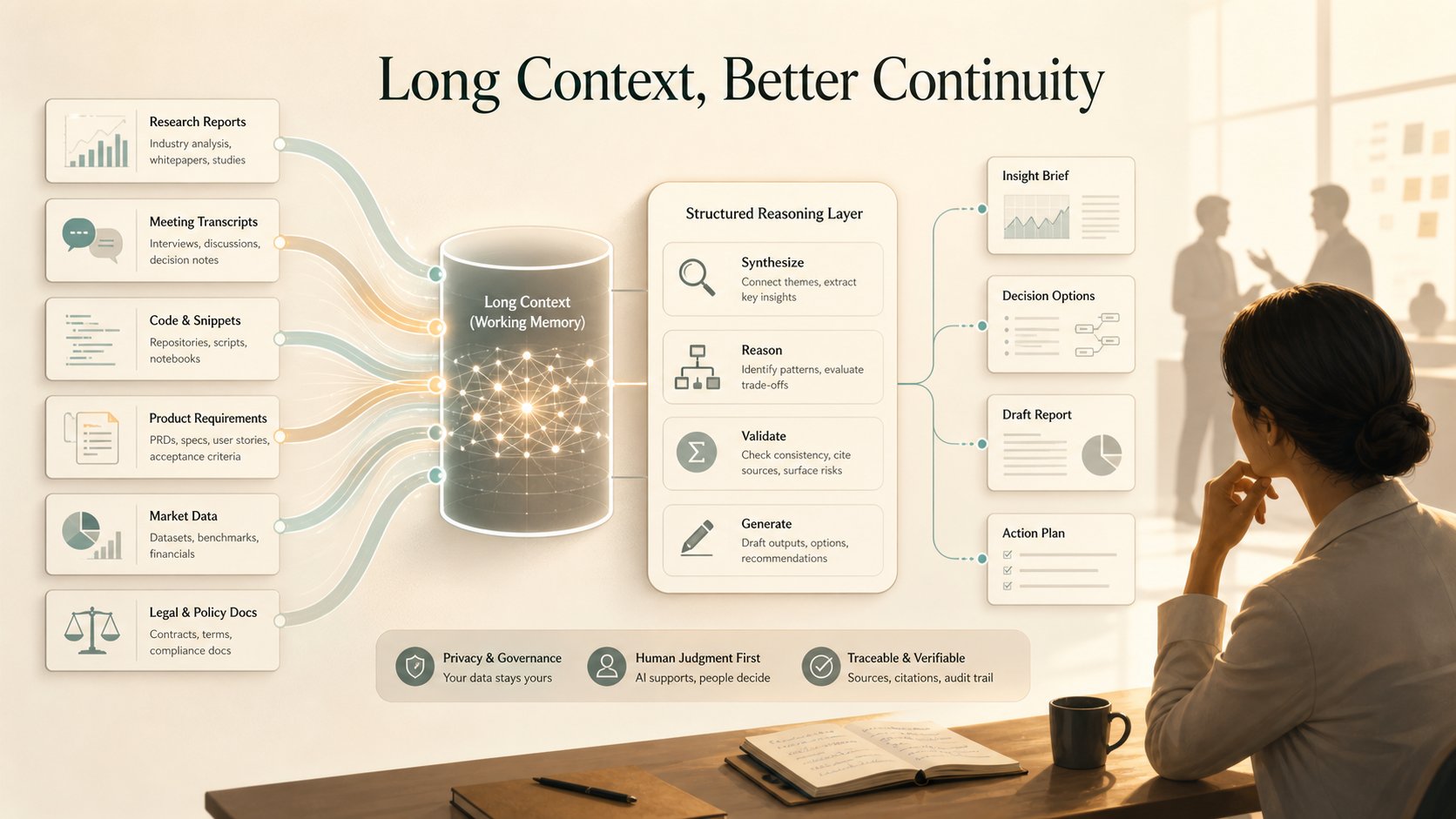
Long context AI matters because professional work rarely fits into a short prompt. A single project may include customer notes, product requirements, technical documentation, meeting transcripts, market data, contracts, and prior presentations. If the model can work with more of that material at once, it may preserve continuity and reduce the time spent cutting documents into smaller pieces.
This can change how people use AI. Instead of treating the model as a quick assistant, teams can use it as a working memory layer across a larger project. A long context window may help the model compare sections of a report, trace decisions across meeting notes, review a broader codebase, or maintain continuity across a research collection.
However, long context is not the same as perfect understanding. Larger input capacity does not remove the need to verify sources, check claims, resolve contradictions, and test assumptions. It can reduce friction, but it does not eliminate professional responsibility.
The Boundary: More Intelligence Does Not Automatically Mean Better Decisions
The biggest risk in discussing Claude Opus 5 is assuming that a more capable model automatically produces better business outcomes. AI can accelerate analysis, but it cannot decide what an organization should value, what risk it should accept, or how a recommendation will land with executives, customers, investors, or regulators.
Professionals still need to check AI output for unsupported claims, missing sources, plausible but incorrect reasoning, overlooked constraints, outdated assumptions, and conclusions that sound polished but are not decision-ready.
This boundary is not a weakness of AI alone. It is a reminder that complex knowledge work has always required judgment. A stronger model may make the work faster and broader, but the final value still depends on human review, domain expertise, and communication quality.
From AI Analysis to Business Communication
Most knowledge work does not end with analysis. It ends with communication. A research project becomes a market research deck. A technical investigation becomes an architecture recommendation. A strategy exercise becomes an executive presentation. A sales analysis becomes a client proposal. An investment thesis becomes a pitch deck.
This is where many AI workflows break down. The model may help produce strong analysis, but the team still has to convert that material into a clear narrative. Leaders do not want every detail. They need the logic, implications, tradeoffs, and recommended action. Clients need a persuasive structure. Investors need a credible story. Internal teams need alignment around what happens next.
The downstream challenge is not just making slides. It is translating complex reasoning into business-ready communication.
Where Pi Fits in the Frontier AI Workflow
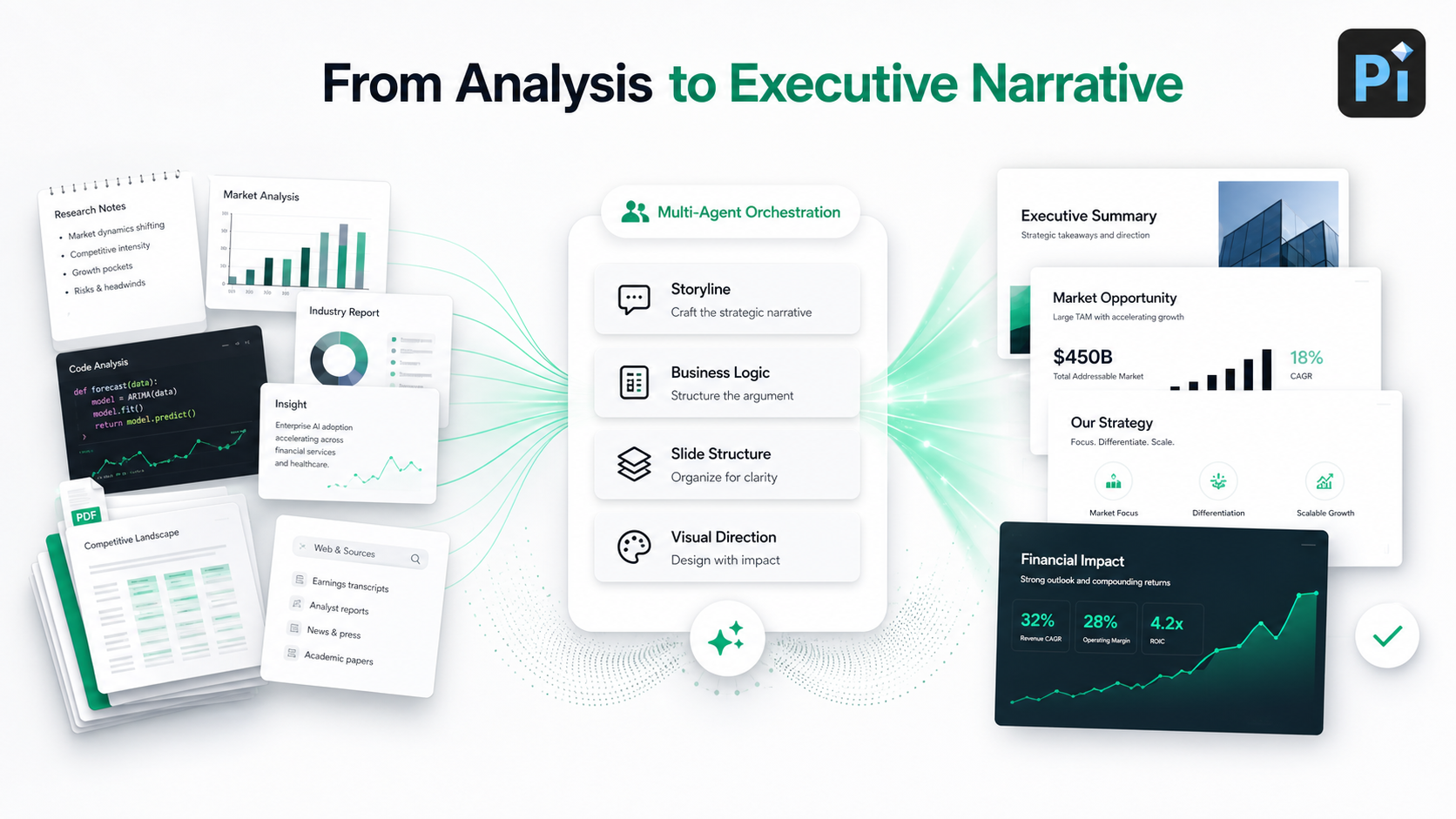
Pi, short for Presentation Intelligence, fits into the workflow after research, reasoning, and analysis have produced useful material. It is not positioned as a replacement for Claude Opus 5 or any other frontier AI model. Instead, Pi is designed for the presentation layer: turning complex inputs into professional business presentations with structure, logic, and visual quality.
Professional presentations need more than attractive layouts. They need a clear argument. Pi helps organize ideas into a business-ready structure, whether the output is an executive presentation, consulting report, product launch deck, sales deck, brand proposal, or investor-ready narrative.
1. Business Logic Comes Before Slide Styling
AI-assisted research often creates too much material: summaries, insights, risks, supporting evidence, and alternative interpretations. Pi helps shape that output into a sequence an audience can follow. The goal is not to include everything, but to clarify the decision path: context, problem, evidence, implication, recommendation, and next step.
This is especially useful for high-stakes business presentation workflows, where the slide order matters as much as the content itself. A strong deck should help stakeholders understand why a recommendation is credible, not just what the recommendation says.
2. Multi-Agent AI Supports the Full Deck Workflow
Pi uses Multi-Agent AI to support different parts of the presentation process, from structure and storyline to slide content and visual direction. That matters because presentation work is rarely one-dimensional. A strong deck must connect business context, audience needs, evidence, messaging, and design.
For example, a market research deck may need an executive summary, segment analysis, competitive implications, customer evidence, and strategic recommendations. A product launch deck may need market context, positioning, narrative flow, rollout logic, and clear visuals. Pi is built for this deeper workflow rather than only producing isolated slides.
3. Premium Visual Quality Improves Credibility
In business settings, visual quality affects credibility. A deck can contain strong thinking but still fail if it looks rushed, inconsistent, or difficult to scan. Pi focuses on premium, business-grade aesthetics so complex work can be presented with clarity and polish.
This does not mean design replaces substance. It means structure, message, and visual hierarchy work together. When teams use frontier AI for analysis and Pi for presentation development, they can move from raw intelligence to a polished communication asset more efficiently.
The Verdict: Claude Opus 5 Matters, but Workflow Matters More
Claude Opus 5 should be understood less as a single release headline and more as a signal of where frontier AI is heading. The market is moving toward models that can support longer context, deeper reasoning, coding assistance, research synthesis, and multi-step professional work.
But competitive advantage will not come from model access alone. Many teams will have access to powerful AI. The difference will come from how well they validate outputs, apply domain judgment, structure conclusions, and communicate recommendations.
If Claude Opus 5 arrives with the capabilities many users expect, it may become an important reasoning and research layer for complex knowledge work. The teams that benefit most will be the ones that pair AI capability with disciplined review and strong communication workflows. Pi is built for that final step: turning complex analysis into polished, business-ready presentations.
Frequently Asked Questions (FAQ)
Q: Has Claude Opus 5 been released?
A: Public details may vary over time, and confirmed capabilities should be checked against official sources. This article focuses on what Claude Opus 5 could represent for frontier AI and complex knowledge work without assuming unconfirmed release details.
Q: What could Claude Opus 5 be used for?
A: Claude Opus 5 may be relevant for research synthesis, document analysis, coding support, technical planning, strategy work, and other tasks that require reasoning across complex information.
Q: Does long context AI replace human review?
A: No. Long context AI can help models work across more material, but professionals still need to verify sources, test assumptions, and make final judgments.
Q: How can teams turn AI research into presentations?
A: Teams can use frontier AI models for analysis and synthesis, then use Pi to structure the output into professional presentations such as executive decks, consulting reports, market research decks, sales decks, or investor-ready materials.