Pitch Deck vs Business Plan: What's the Difference?
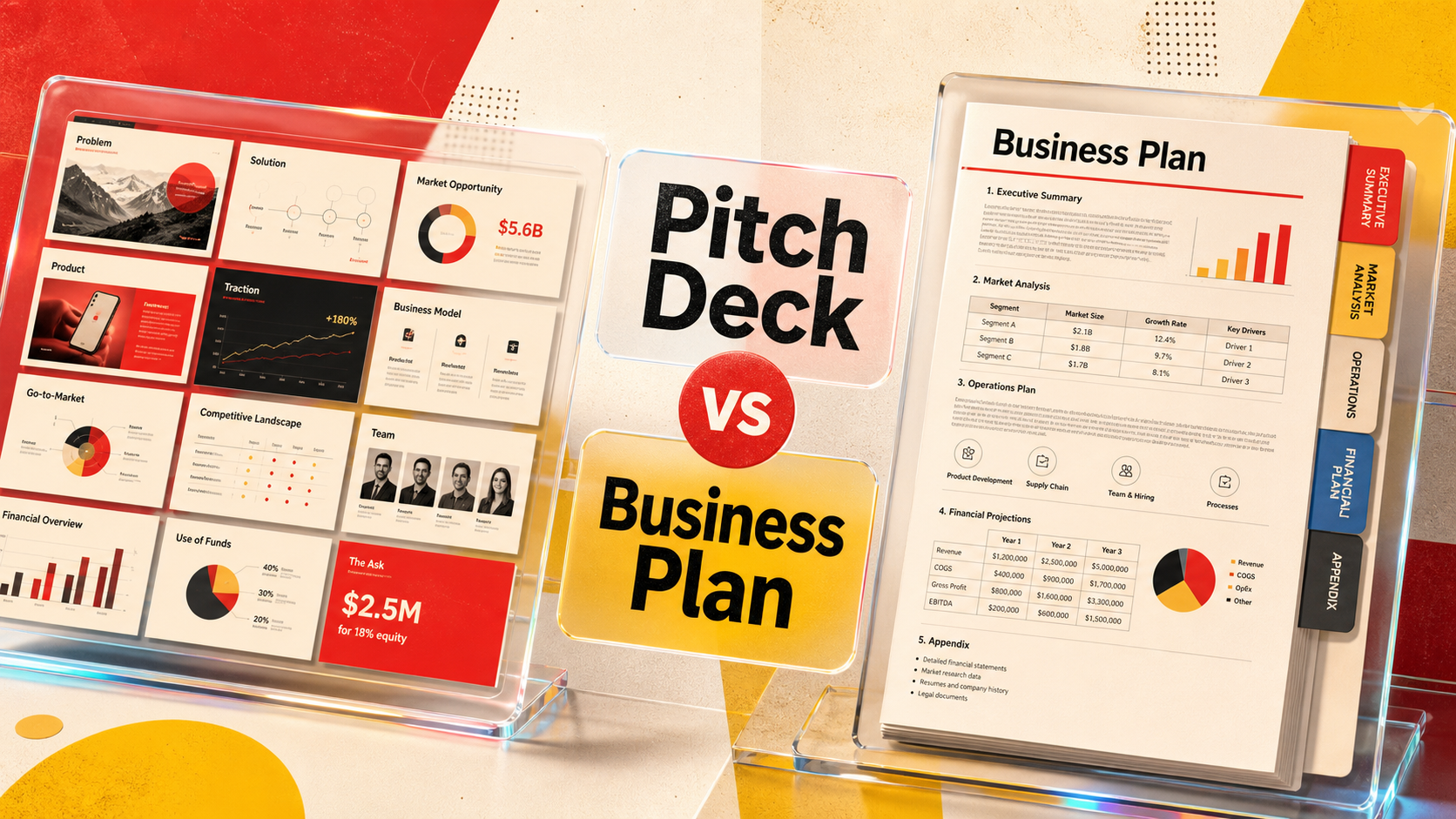
The difference between a pitch deck and a business plan matters because each document supports a different business conversation. If you are comparing pitch deck vs business plan, the key distinction is not just length. A pitch deck communicates quickly and persuades visually. A business plan documents, analyzes, and explains in depth.
Founders, students, and business teams may need both, but not always at the same time. The pitch deck opens the door with a focused story. The business plan supports planning, diligence, financing review, or internal alignment. Choosing the right format helps you match the document to the audience, the decision, and the stage of the business.
The Short Answer
A pitch deck is a concise visual presentation, often 10 to 15 slides, used to explain a business opportunity. It is usually created for investors, partners, executives, or stakeholders who need to understand the business quickly and decide whether to continue the conversation.
A business plan is a detailed written document that explains how the business works and how it intends to grow. It typically covers market analysis, business model, operations, financial projections, execution risks, and strategic assumptions.
In simple terms: a pitch deck is for communication and persuasion; a business plan is for documentation and planning. They may cover similar topics, but they are built for different reading experiences.
What Is a Pitch Deck?
A pitch deck is a structured presentation that explains the most important parts of a business in a clear, compelling sequence. It usually includes the problem, solution, market opportunity, product, traction, business model, go-to-market strategy, team, competition, financial highlights, and funding ask.
The typical audience includes venture investors, angel investors, startup accelerators, strategic partners, senior leadership teams, and startup competition judges. In these situations, the audience is not looking for every operational detail at first. They want to know whether the opportunity is credible, differentiated, scalable, and worth further discussion.
A strong pitch deck prioritizes narrative, clarity, visual structure, and a convincing business case. It should help the audience quickly answer: What problem is being solved? Why now? Why this team? Why can this company win?
Because a pitch deck is presentation-first, it must work both in a live meeting and as a shared PDF. It is not a data dump. It is a focused argument.
What Is a Business Plan?
A business plan is a comprehensive written document that explains the company’s strategy and execution path. It may be used by founders, management teams, banks, grant committees, corporate stakeholders, or internal planning groups.
A business plan often includes the company overview, customer segments, market research, competitive analysis, product or service strategy, pricing, operations, sales and marketing plan, hiring assumptions, revenue model, financial projections, and risk factors. It may also include supporting detail that would be too dense for a pitch deck.
The purpose is not only to persuade. A business plan also tests assumptions, clarifies execution, and creates a shared operating view. A lender may want to understand repayment logic and cash flow. A leadership team may use it to align departments around priorities and milestones.
Pitch Deck vs Business Plan: Key Differences
| Comparison Area | Pitch Deck | Business Plan |
| Primary purpose | Communicate and persuade | Explain and document |
| Main audience | Investors, partners, executives | Internal teams, lenders, reviewers |
| Format | Visual presentation | Written document |
| Typical length | 10–15 slides | 20–50+ pages |
| Level of detail | Selective and high-impact | Comprehensive and analytical |
| Timing | Early conversations and meetings | Planning, diligence, financing review |
| Typical use case | Fundraising pitch or stakeholder presentation | Operational planning or formal review |
The most important difference is communication intent. A pitch deck compresses the business into a persuasive story. A business plan expands the business into detailed operating logic. This business plan comparison is useful because both documents may discuss the same company, but they do not present it in the same way.
When You Need a Pitch Deck
You need a pitch deck when your audience has limited time and needs to understand the opportunity quickly. This is common in early investor outreach, first meetings, demo days, partner conversations, board previews, or executive alignment sessions.
The goal is not to answer every possible question. The goal is to earn attention, create confidence, and move the conversation forward. If the audience understands the business and wants to know more, the deck has done its job.
A pitch deck is especially useful when the situation requires:
- A concise story that can be presented live
- A professional document that can be shared after the meeting
- A clear explanation of market opportunity and business potential
- A visual structure that helps busy stakeholders absorb the message
For startups, the pitch deck is often the most important external communication asset. It turns strategy into a narrative that investors and partners can evaluate quickly.
When You Need a Business Plan
You need a business plan when the situation requires deeper analysis, written documentation, or detailed execution planning. This may include internal strategy work, bank loan applications, grant submissions, franchise planning, operational planning, or formal due diligence.
A business plan is also useful when a team needs to align on assumptions before committing resources. If leaders disagree about target customers, pricing, sales channels, hiring plans, or cash requirements, a business plan can force the right discussions.
Unlike a pitch deck, a business plan is not optimized for a short meeting. It is designed for careful review. Readers may examine assumptions, challenge projections, and look for evidence behind the strategy. That makes it stronger for analysis, but weaker for quick persuasion.
Do You Need Both?
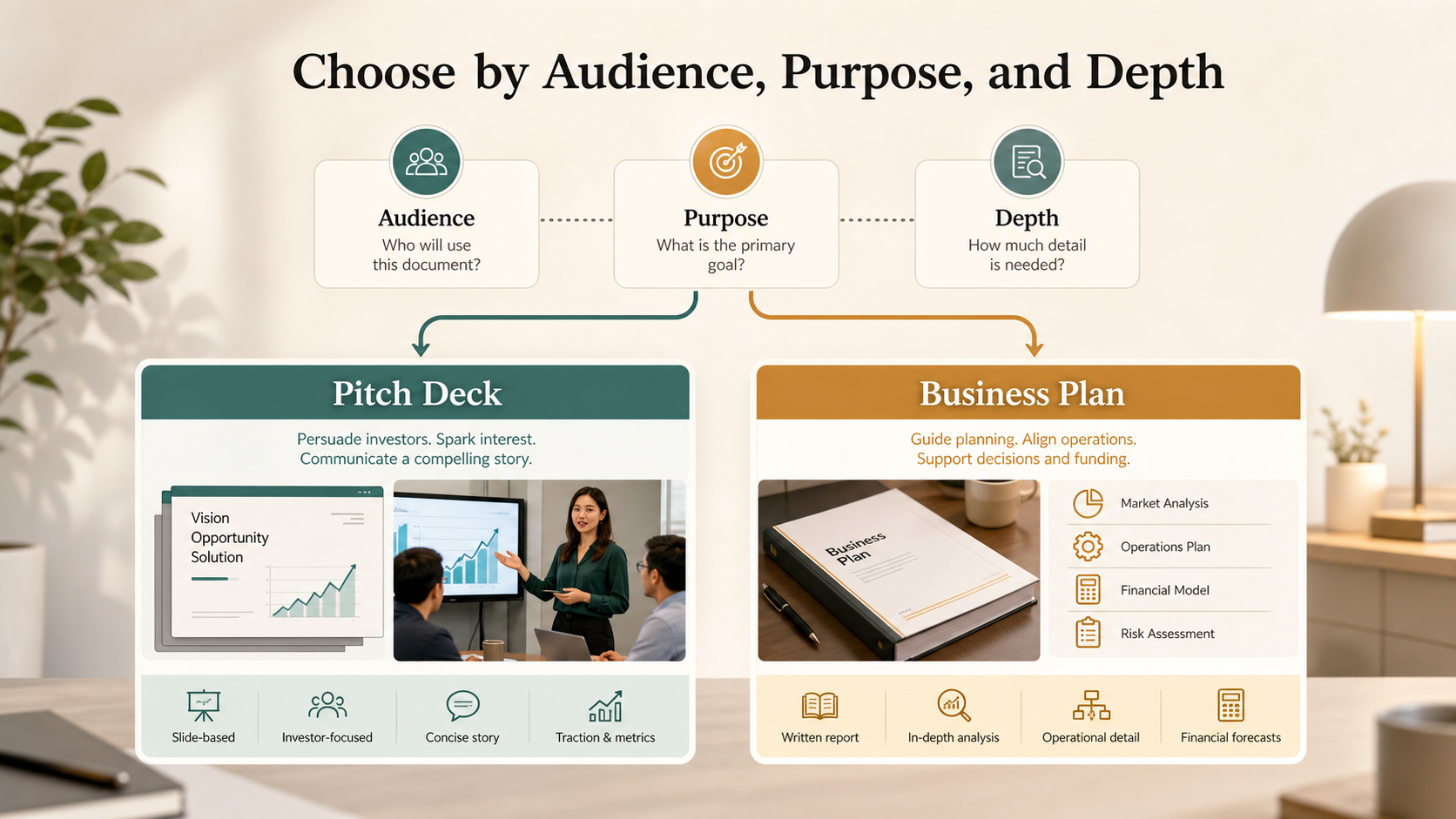
Many serious businesses eventually need both, but not always immediately. A founder may begin with strategy notes, a lean business plan, or a financial model. From there, the most important points can be translated into a pitch deck for investor or partner conversations.
The relationship works in both directions. A business plan can provide the depth behind a pitch deck, while a pitch deck can reveal whether the strategy is clear enough to communicate. If the deck feels confusing, the underlying business logic may need more work. If the business plan is detailed but impossible to summarize, the team may need sharper positioning.
The strongest teams treat these as complementary startup documents. The pitch deck helps others understand the opportunity. The business plan helps the team understand the execution path.
How Pi Helps Turn Business Strategy Into a Pitch Deck
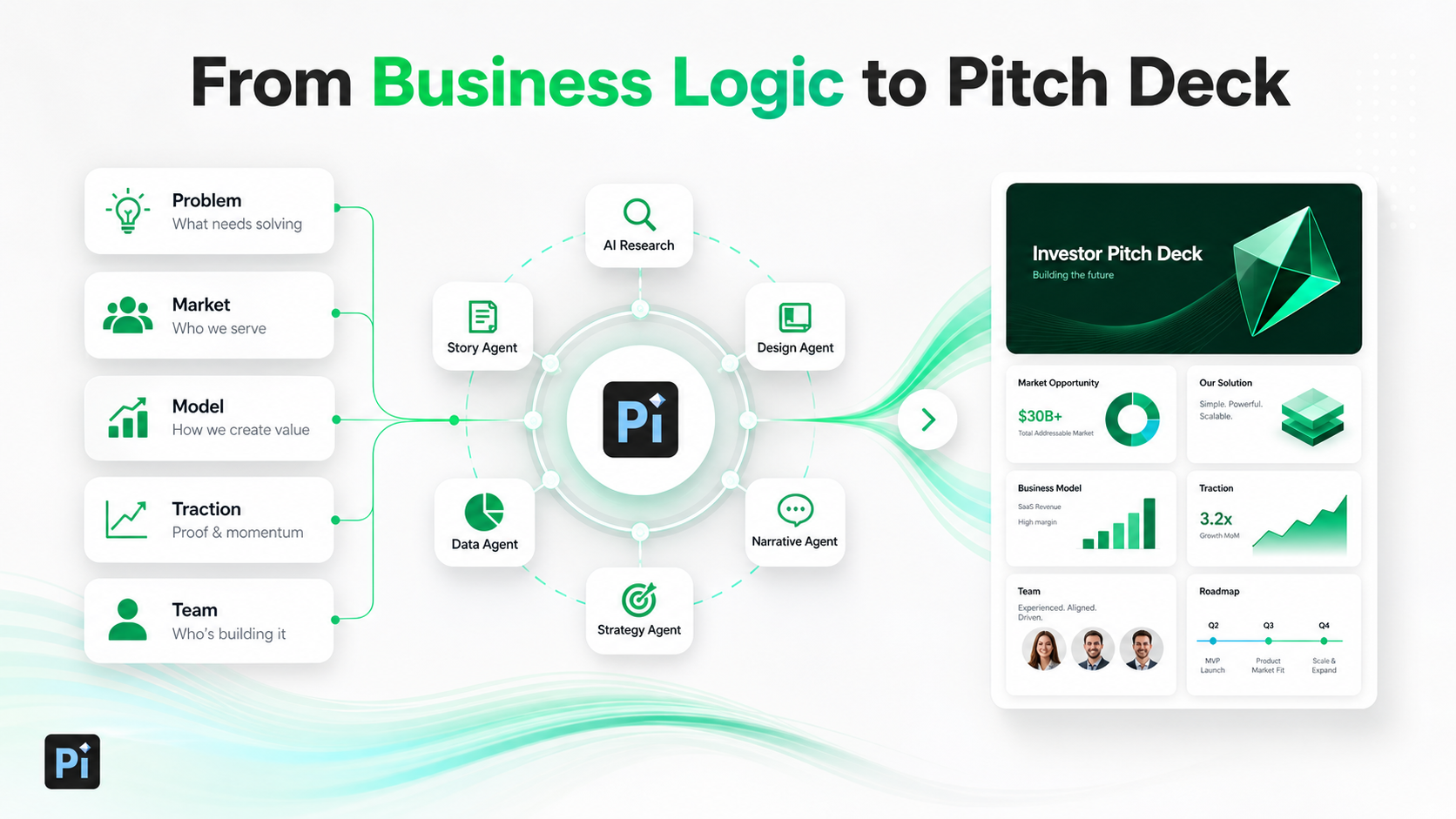
Once the business logic is clear, the next challenge is communication. Many teams have strong ideas, but their slides fail to show the strategy with enough structure, polish, or narrative flow. Pi, short for Presentation Intelligence, is an AI presentation maker built to help professionals turn business thinking into high-quality presentation form.
1. Business Logic Comes Before Slide Styling
Pi helps structure the story before focusing on visuals. For a pitch deck, that means organizing the business case around the audience’s decision process: problem, market, solution, traction, model, team, and next step. The result is not just a prettier PPT. It is a clearer business narrative.
2. Multi-Agent AI Supports the Workflow
Pi uses Multi-Agent AI to support different parts of the presentation process, from structure and messaging to layout and refinement. This is useful for teams that need more than a generic slide draft. A pitch deck has to connect strategy, evidence, and persuasion in a tight sequence.
3. Professional Design Helps the Message Land
High-stakes business presentations also need to look professional without distracting from the message. Pi helps create pitch decks with business-grade aesthetics, consistent hierarchy, and polished slide design. It does not replace strategic thinking or a full business plan when deeper documentation is required. It is most useful when a founder or team understands the business and needs to present it clearly.
A Practical Verdict for Founders and Teams
Use a pitch deck when you need to communicate quickly, visually, and persuasively. Use a business plan when you need detail, documentation, financial logic, and execution clarity.
For fundraising, a pitch deck is often the right first document because it helps investors understand the opportunity fast. For bank financing, internal planning, or structured diligence, a business plan may be more appropriate because it provides deeper support.
The best approach is not to choose one forever. Build the level of thinking your business requires, then convert that thinking into the format your audience needs. A strong business plan can support a stronger pitch deck, and a strong pitch deck can expose whether the business plan is clear enough to matter.
Frequently Asked Questions (FAQ)
Q: Is a pitch deck the same as a business plan?
A: No. A pitch deck is a concise visual presentation designed to communicate and persuade. A business plan is a detailed written document designed to explain strategy, operations, financial assumptions, and execution.
Q: Do investors prefer a pitch deck or a business plan?
A: Many venture investors prefer to review a pitch deck first because it is faster to assess. If they are interested, they may ask for financial models, customer data, or more detailed planning documents.
Q: Can I create a pitch deck from a business plan?
A: Yes. A business plan can provide the source material, but it should not be copied slide by slide. The pitch deck should extract the strongest points and turn them into a clear, persuasive story.
Q: How long should a pitch deck or business plan be?
A: A pitch deck is often 10 to 15 slides. A business plan may range from 20 to 50 pages or more, depending on its purpose, complexity, and review requirements.
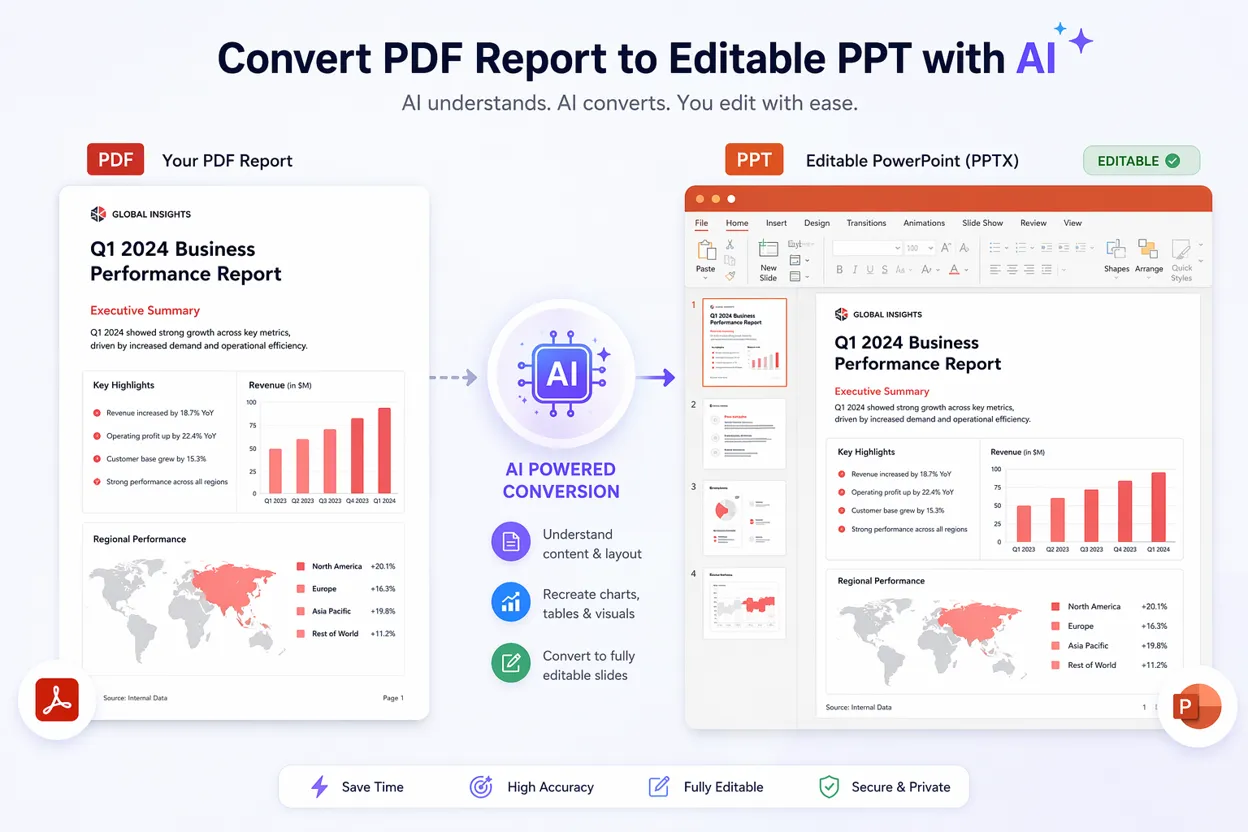 PDF to PPT with AI: Convert Reports into Editable Presentations