Why AI Pilots Fail: What the GenAI Divide Reveals About Enterprise AI ROI
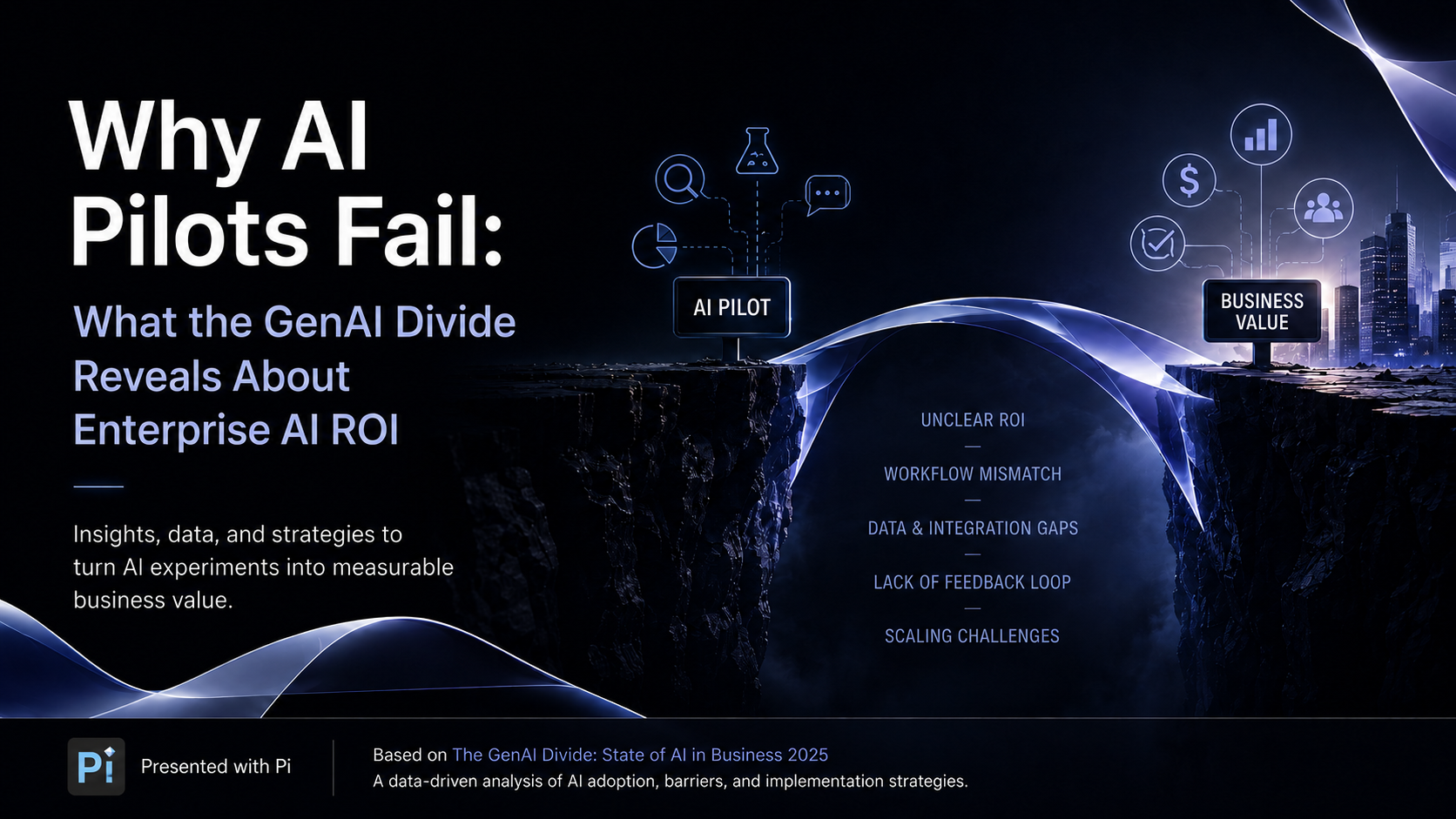
Launching an AI pilot is easy. Turning it into a dependable business system is not.
A team can connect a model, upload internal documents, and produce an impressive demonstration within days. Production introduces incomplete data, access controls, legacy software, approval steps, unusual cases, and employees with established routines.
The distance between these environments explains why enterprise AI adoption can rise without producing the expected financial return. IBM’s 2025 CEO Study found that only 25% of surveyed executives’ AI initiatives had delivered the expected ROI, while 16% had scaled across the enterprise.
Deloitte’s State of Generative AI in the Enterprise offers a useful counterpoint. More than two-thirds of surveyed organizations expected 30% or fewer of their experiments to be fully scaled within the next three to six months. However, nearly three-quarters said their most advanced initiative was meeting or exceeding ROI expectations.
Together, these findings reveal the GenAI Divide: experiments are common, but measurable value is concentrated in projects that become part of real workflows.
AI Adoption Is Not Enterprise AI ROI
An employee using AI to summarize a meeting or prepare a first draft is evidence of adoption. It is not necessarily evidence of transformation.
Enterprise AI ROI appears when a system changes a recurring process. It may shorten contract review, reduce support escalations, accelerate reporting, lower external service costs, or allow a team to manage more work without proportional hiring.
Many pilots are evaluated using the wrong signals. Teams measure prompt volume, generated content, or positive reactions during demonstrations. Those indicators may show interest, but they do not establish business value.
A production-minded pilot must answer three questions:
1.Can the AI perform the task accurately?
2.Can employees use it reliably inside the workflow?
3.Does the improved workflow affect cost, revenue, risk, or capacity?
Why AI Pilots Fail Before Production
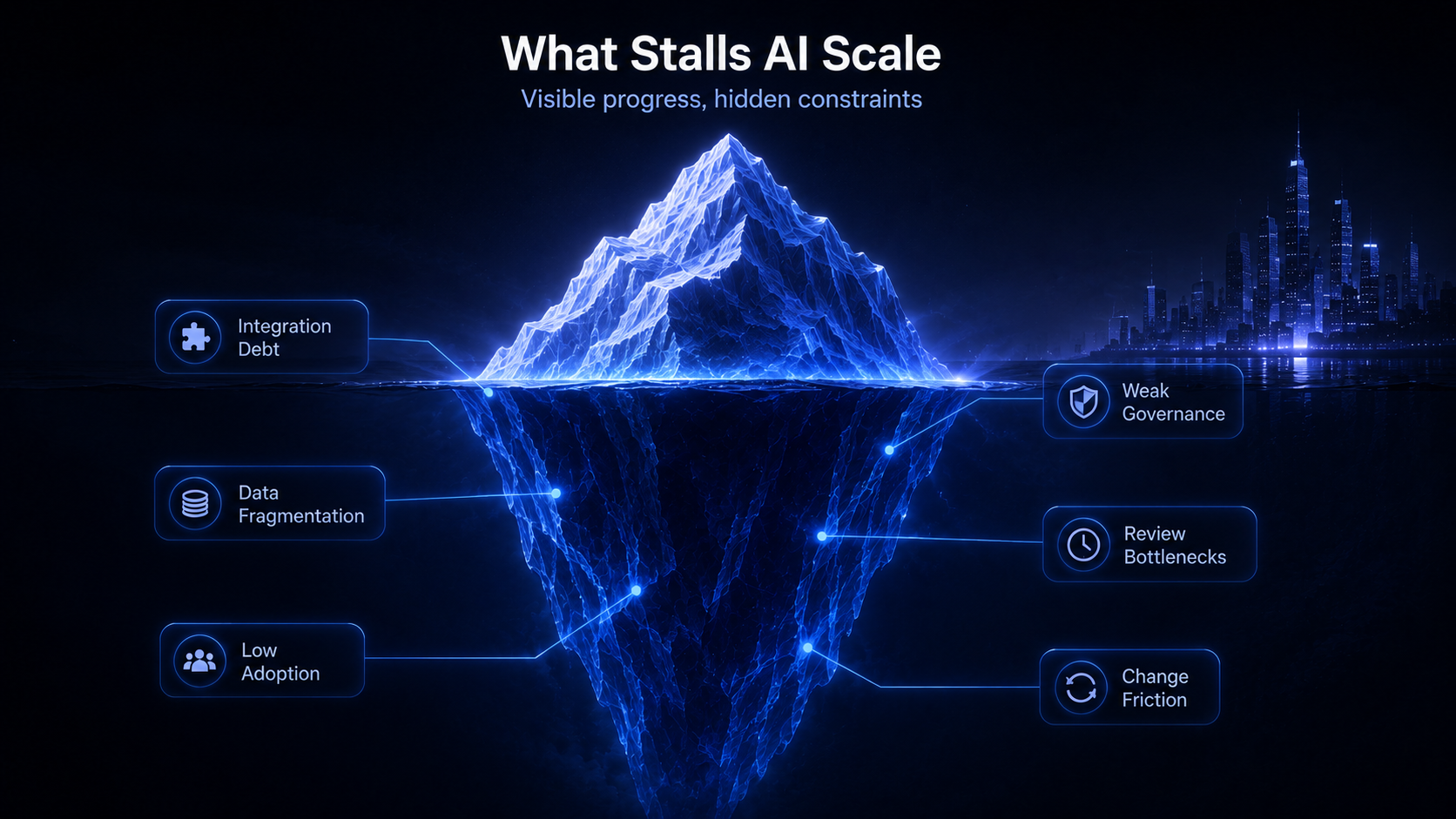
1. The Project Starts With the Tool
A weak pilot begins with a new AI product and searches for somewhere to use it. A stronger pilot begins with an expensive, slow, error-prone, or capacity-constrained process.
Before testing AI, the team should document how often the task occurs, how long it takes, who completes it, where delays appear, and how much review is required. It should also define the improvement needed to justify deployment.
Without a baseline, success becomes subjective. One stakeholder sees a polished answer and calls the pilot transformative. Another sees one mistake and calls it unsafe. Neither reaction proves whether the workflow improved.
2. The AI Sits Beside the Workflow
A model can accelerate one task while making the complete process more complicated.
Employees may copy information from one platform, paste it into an AI interface, review the response, rewrite part of it, and move it back into another system. The model has produced an answer, but the organization has added handoffs.
A scalable system needs defined entry and exit points. Where does the input originate? What information can the model access? Which outputs require approval? What happens when data is missing? Where is the final action recorded?
The value is not contained in the generated answer alone. It appears in what the organization can do next.
3. The System Does Not Understand the Organization
Enterprise work depends on context that general-purpose tools do not automatically possess.
A useful system may need to understand internal terminology, approved evidence, customer history, pricing rules, policy exceptions, preferred formats, and earlier corrections. When users must rebuild this context during every session, the tool remains helpful for occasional tasks but becomes frustrating for repeated work.
The missing layer may involve retrieval, structured data, memory, integrations, or feedback. Model intelligence matters, but organizational intelligence often determines whether a system becomes dependable.
4. Nobody Owns the Production Outcome
Innovation teams can launch experiments, but production systems require permanent owners.
Someone must be accountable for adoption, data access, quality thresholds, exception handling, employee training, vendor performance, and continuous improvement. Without that owner, the pilot reaches the end of its testing period and becomes an expensive browser bookmark.
Ownership should be assigned before development begins. The owner also needs authority to change the surrounding workflow.
5. Governance Arrives Too Late
Security, legal, compliance, and risk teams are sometimes invited only after the demonstration is complete. By then, the pilot may depend on restricted data, unsupported integrations, or outputs that cannot be explained or audited.
The NIST Generative AI Profile recommends incorporating trustworthiness considerations throughout the design, development, use, and evaluation of generative AI systems.
Teams should identify sensitive data, foreseeable failure modes, human-review requirements, logging needs, and rollback procedures at the beginning. Early governance defines a safe route forward. Late governance often sends the project back to the starting line.
How to Design an AI Pilot That Can Scale
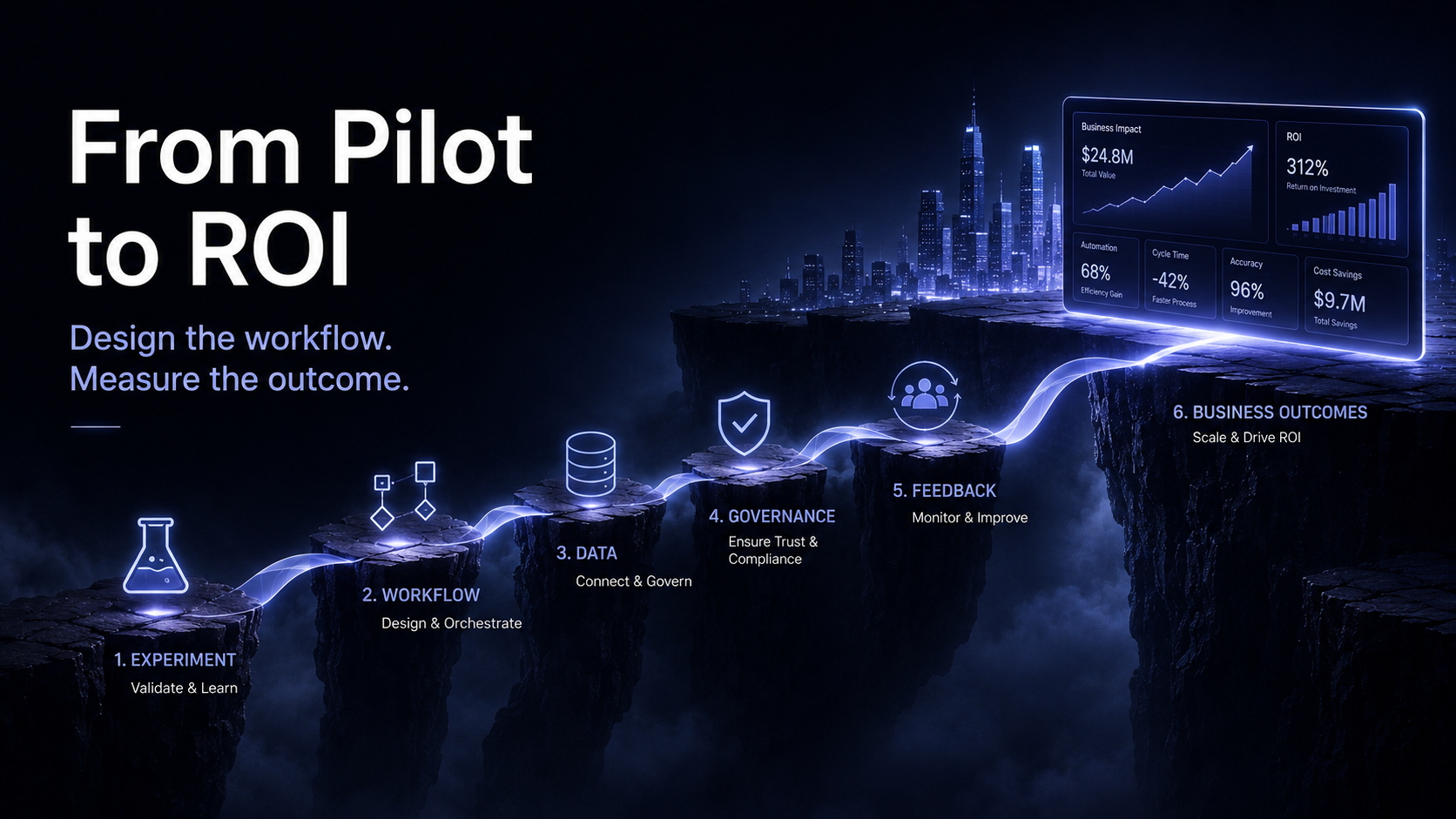
1. Choose a Narrow, Repeated Workflow
The strongest first use case is rarely the most ambitious one. It is usually a process with clear boundaries, frequent demand, and results that can be evaluated.
Suitable candidates include document classification, customer-request routing, recurring report preparation, internal knowledge retrieval, and extracting standard information from forms.
2. Evaluate the Whole Process
Model accuracy is necessary, but it is not a complete business case. A production-ready pilot should be evaluated at three levels.
Output quality: Is the result accurate, complete, consistent, and appropriately sourced?
Workflow performance: Does the process reduce time, rework, handoffs, or human-review effort?
Business impact: Does the improvement affect cost, revenue, risk, customer experience, or operational capacity?
A model can generate better content without improving the workflow. A faster workflow may still be too small to justify deployment.
3. Design Human Review Intentionally
Full automation is not the only successful outcome.
In many enterprise workflows, AI can handle predictable cases while specialists review exceptions. The purpose is not to remove people at any cost. It is to place human judgment where it creates the most value.
Teams should measure how often intervention is required, how much editing remains, and which errors create meaningful risk.
4. Build a Feedback Loop
Every correction, rejection, and escalation contains information.
Teams can use this evidence to improve prompts, retrieval sources, approval rules, interfaces, and evaluation criteria. Without a feedback loop, the same errors return and employee trust erodes.
Where Enterprise AI ROI Often Appears First
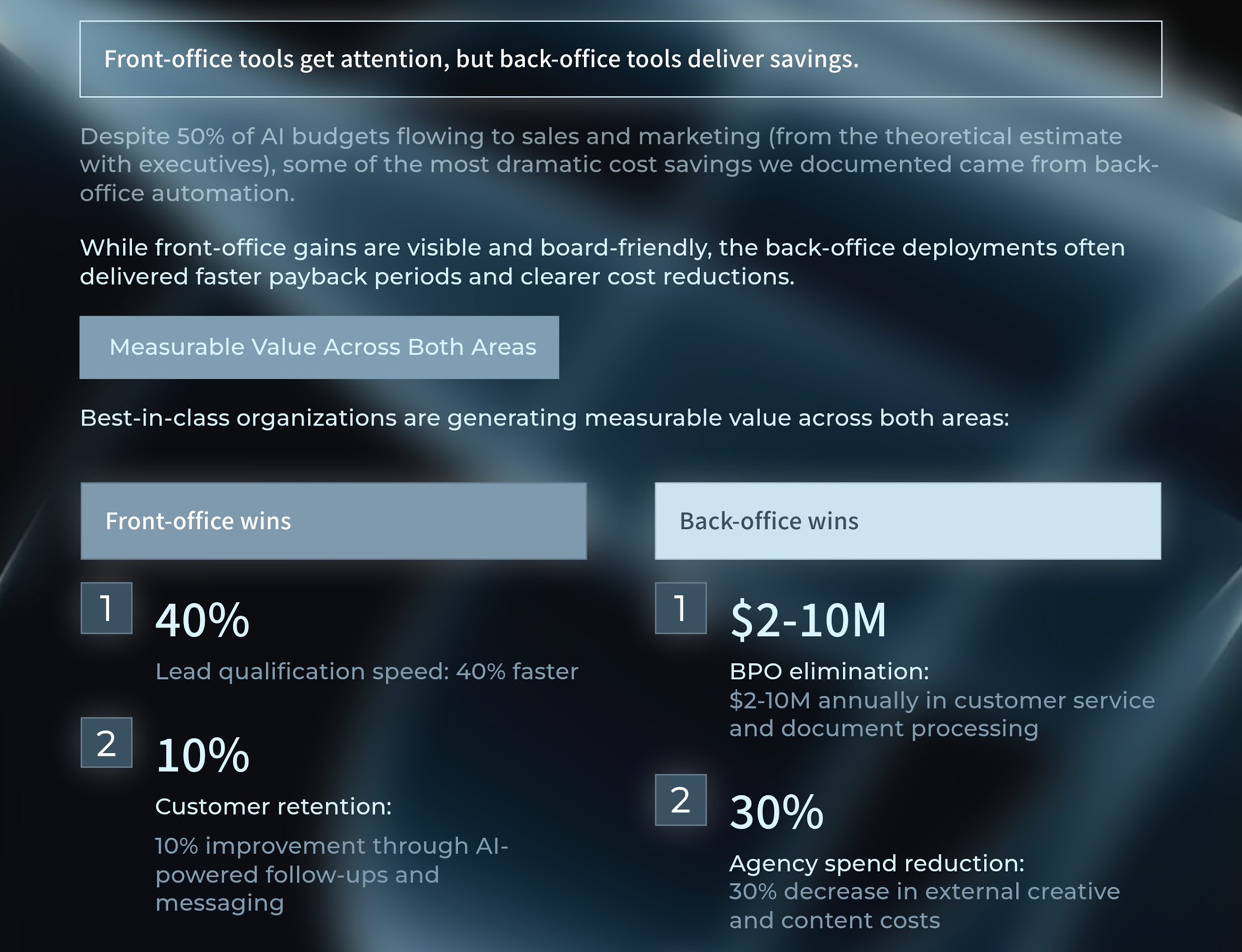
The most visible use cases are not always the most valuable.
Customer-facing assistants and creative tools attract attention because their outputs are easy to demonstrate. Back-office workflows may produce clearer economics because they involve repeated labor, processing time, external service costs, and measurable error rates.
Early enterprise AI ROI may come from reducing document-processing time, shortening support queues, accelerating compliance reviews, improving internal reporting, lowering outsourced service costs, or increasing employee capacity without proportional hiring.
Companies should separate personal productivity from enterprise value. Saving one employee twenty minutes is useful. Enterprise ROI appears when that saving is repeatable, adopted across the intended population, and connected to a measurable outcome.
See the GenAI Divide as a Visual Business Narrative
The GenAI Divide becomes easier to understand when adoption data, pilot barriers, procurement choices, and implementation patterns are placed in one structured story.
Explore The GenAI Divide: State of AI in Business 2025, created with Pi, to see how dense enterprise AI research can be transformed into a clear presentation for leadership discussions, strategy reviews, and investment decisions.
Ready to turn your own reports, research, or business documents into a decision-ready deck?
Create a presentation with Pi and organize complex source material into a coherent visual narrative.
Frequently Asked Questions (FAQ)
Q: Why do AI pilots fail to scale?
A: AI pilots often fail because they are disconnected from real workflows, lack measurable objectives, depend on incomplete organizational context, or have no permanent owner responsible for production.
Q: How should companies measure enterprise AI ROI?
A: Companies should compare the AI-enabled process with a documented baseline. Useful metrics include time per task, human-review effort, error rate, cost per transaction, adoption, revenue impact, and avoided external spending.
Q: What is the GenAI Divide?
A: The GenAI Divide describes the gap between organizations experimenting with generative AI and those achieving sustained operational or financial value from integrated AI systems.
Q: Should companies build or buy enterprise AI systems?
A: The choice depends on workflow uniqueness, internal expertise, integration requirements, security, and long-term ownership. The stronger option is the one that fits the real process, improves through feedback, and has a credible path to production.