What Is a Pitch Deck?
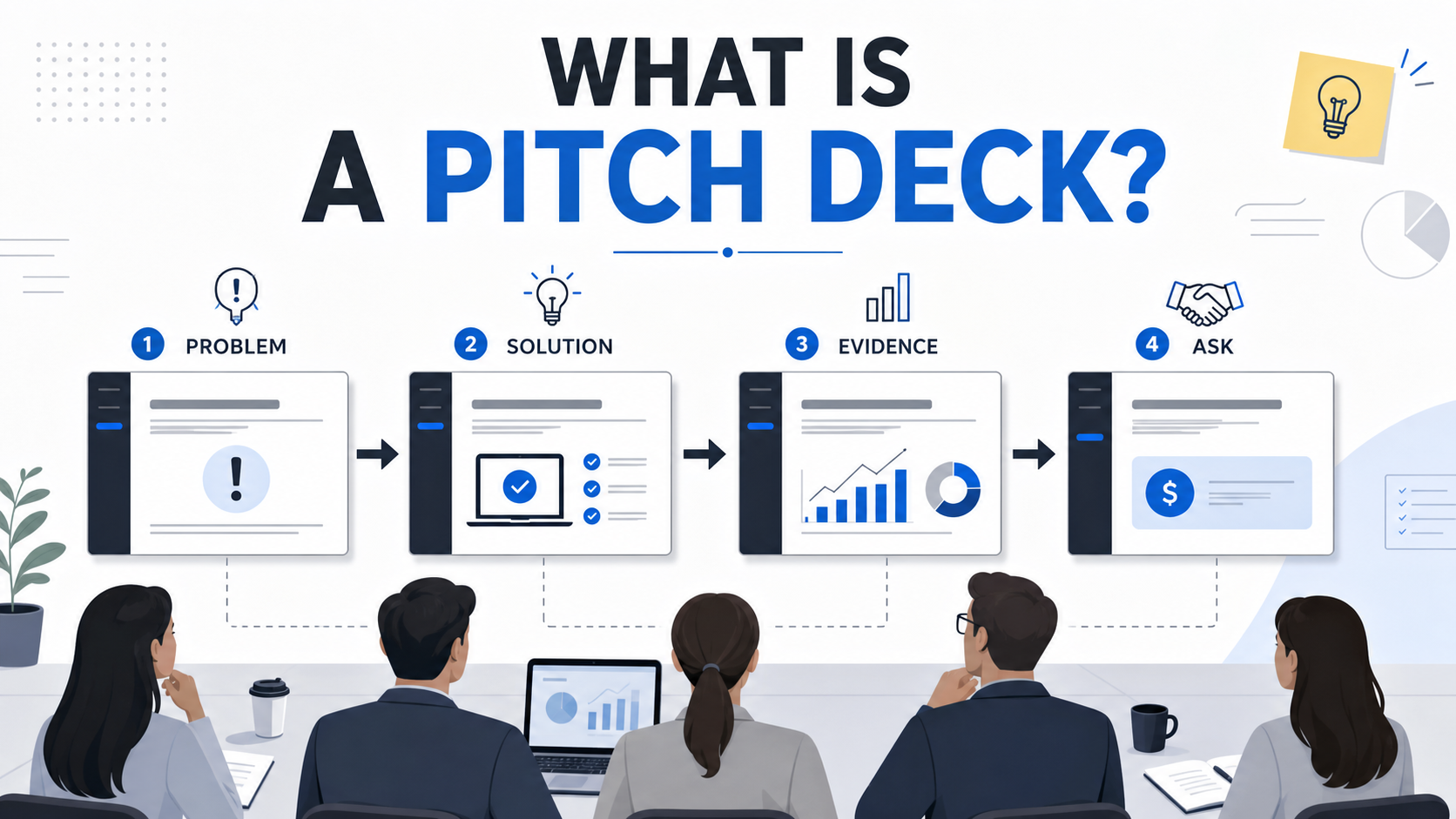
A pitch deck is a concise business presentation used to explain an opportunity and persuade a specific audience to take a next step. In simple terms, the pitch deck definition is: a short, structured deck that presents a problem, introduces a solution, shows why the opportunity matters, and makes a clear ask.
The pitch deck meaning is often connected to startup fundraising, but it is broader than that. Teams use pitch decks for investor meetings, sales conversations, partnership proposals, product launches, internal approvals, and strategic initiatives.
A strong pitch deck is not just a polished set of slides. It is a structured argument. It helps the audience understand what is happening, why it matters, why your solution is credible, and what decision you want from them.
Pitch Deck Meaning in Business Context
In business, a pitch deck is useful when an idea needs to be understood quickly. The audience may not have time to read a long document, review a spreadsheet, or attend multiple discovery meetings. A deck gives them a focused view of the opportunity.
For startups, a pitch deck usually supports investor conversations. It explains the company, market, product, business model, traction, team, and fundraising ask. For established companies, the same format can support sales proposals, market-entry plans, partnership discussions, or executive approvals.
That is what separates a pitch deck from a general presentation. It is not only sharing information. It is designed to move the audience toward a decision.
What a Pitch Deck Is Designed to Do
A pitch deck turns an opportunity into something the audience can understand, evaluate, and act on. The best decks make the business logic easy to follow.
At a basic level, a pitch deck should clarify:
- The problem or opportunity being addressed
- The solution or idea being proposed
- The value for the market, customer, or organization
- The evidence that supports credibility
- The specific next step being requested
This boundary matters because weak pitch decks often try to include too much. They show every feature, chart, milestone, and internal detail. But a pitch deck is not a complete archive of the business. It is a selective presentation built to help an audience decide whether to continue.
What Slides Are Usually Included in a Pitch Deck?
A pitch deck does not have one fixed format, but strong decks often follow a recognizable structure. The exact order depends on the audience and purpose, yet the core sections are usually similar.
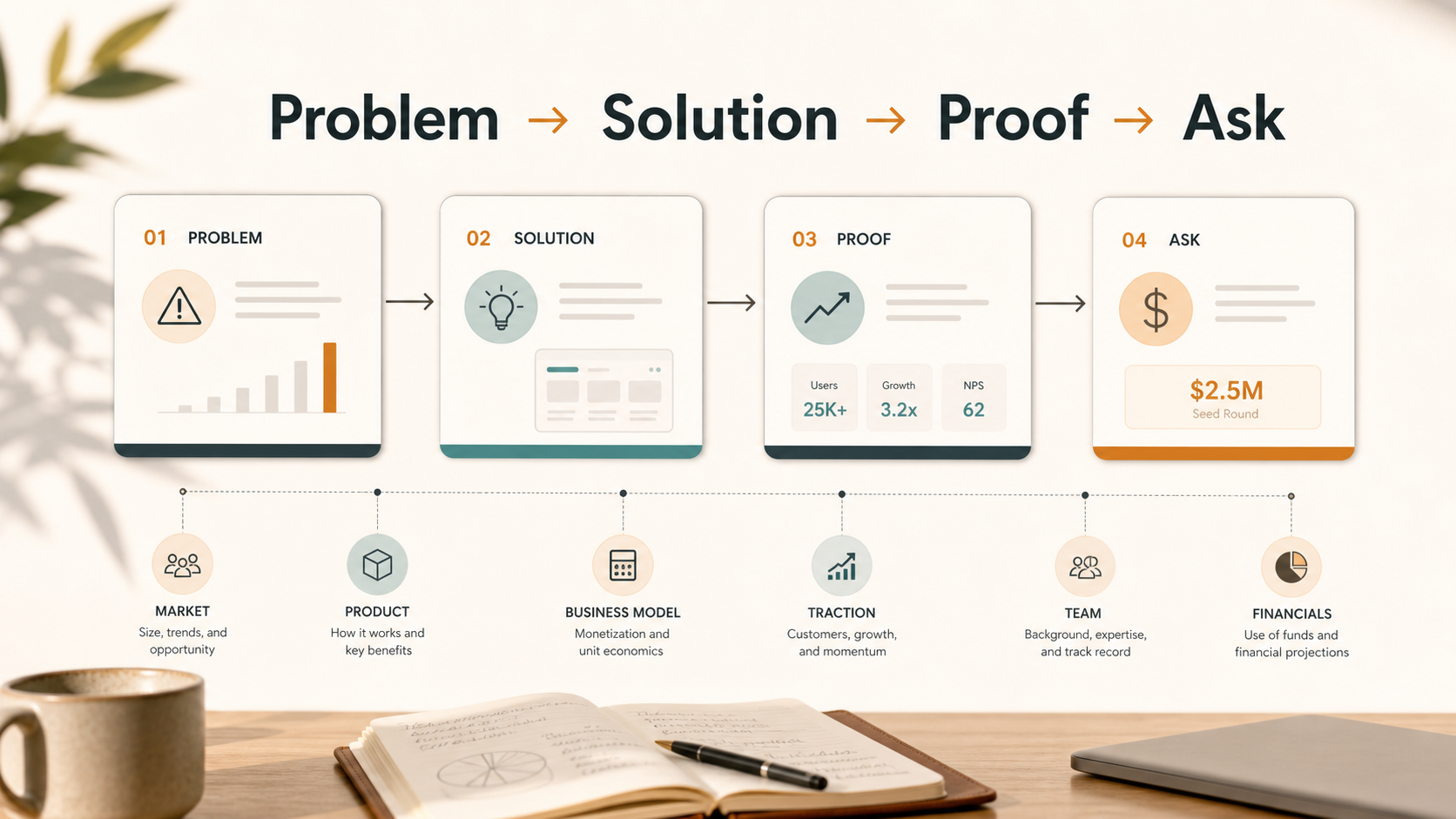
The problem slide explains the pain point, unmet need, or business gap. The solution slide introduces your product, service, model, or initiative as the answer to that problem.
A market or opportunity slide shows the scale of the potential. In a startup presentation, this may include market size or customer segments. In a corporate pitch, it may show revenue potential, cost savings, strategic fit, or competitive urgency.
The product or offering section explains what you are building or proposing. The business model slide explains how value is created and captured, such as through subscriptions, licensing, services, transactions, or another model.
Traction is where credibility becomes important. This section may include customer growth, revenue, pilot results, partnerships, usage data, case studies, or other proof that the idea is working. Competition or positioning explains how the solution compares with alternatives and why it has a defensible place in the market.
A go-to-market slide describes how the team will reach customers or users. The team slide explains why the people involved can execute the plan. Financials summarize key projections, economics, or funding needs. Finally, the ask states what you want from the audience, such as investment, approval, partnership, a pilot, or a next meeting.
Pitch Deck vs. Startup Presentation vs. Business Plan
The terms pitch deck, startup presentation, and business plan are often used together, but they are not identical.
| Format | Primary Purpose | Typical Depth |
| Pitch deck | Persuade a target audience to take a next step | Concise and selective |
| Startup presentation | Present startup-related information in a broad sense | Varies by use case |
| Business plan | Document strategy, operations, market, and financial details | Detailed and document-like |
A startup presentation can refer to almost any deck about a startup: an investor update, product demo, hiring presentation, board update, or sales deck. A pitch deck is more specific. It is built to persuade a defined audience around a defined opportunity.
A business plan is usually more detailed than a pitch deck. It may include deeper analysis, operational plans, financial assumptions, risk assessments, and supporting documentation. A pitch deck may summarize parts of a business plan, but it should not try to replace all of that detail.
What Makes a Pitch Deck Effective?
An effective pitch deck starts with audience relevance. Investors may care about market size, growth, defensibility, and return potential. Customers may care about pain points, value, implementation, and proof. Executives may care about strategic fit, ROI, risk, and resource requirements. The same idea may need different versions for different audiences.
Strong pitch decks also have a clear narrative. Each slide should answer the natural next question. If the problem is serious, why is your solution suited to solve it? If the solution is strong, why now? If the market is attractive, how will you reach it? If the plan is ambitious, why is the team credible?
Concise slide structure matters too. Each slide should have a clear point, not just a topic label. A headline like “Referral growth is reducing acquisition cost” is more useful than “Traction” because it tells the audience what to notice.
Evidence is another key ingredient. Claims should be supported by data, examples, customer signals, financials, or experience. The deck does not need to prove everything in full detail, but it should provide enough confidence to continue the conversation.
How Pi Helps Teams Create Business-Ready Pitch Decks
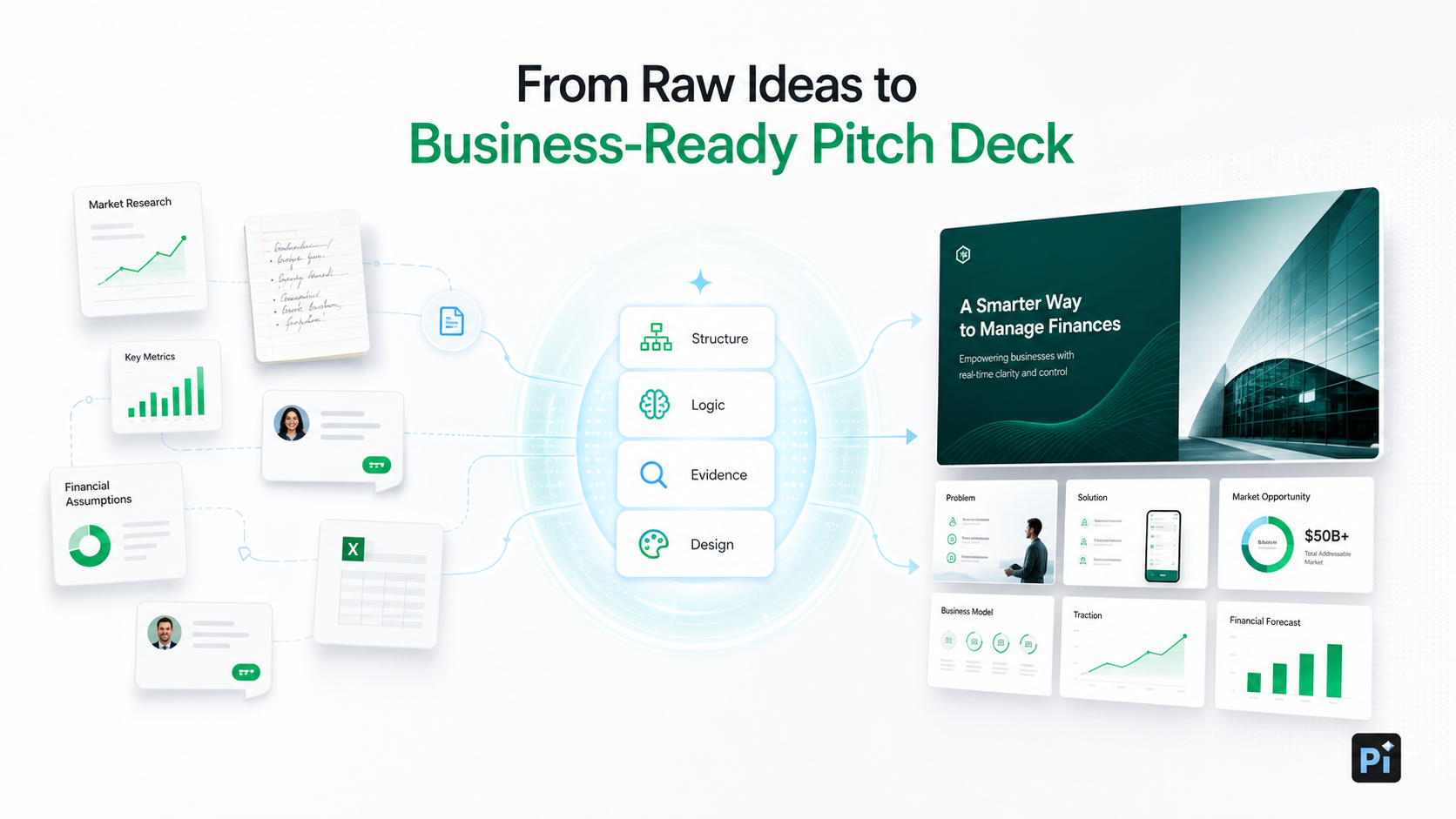
Once you understand what a pitch deck needs to accomplish, the challenge becomes execution. Teams often have raw notes, market research, product details, financial assumptions, and stakeholder feedback, but turning that material into a clear deck takes time. Pi, short for Presentation Intelligence, is an AI presentation maker designed for professional business presentations where structure, logic, and visual quality matter.
Pi helps teams move from scattered information to a business-ready structure. For a pitch deck, that means organizing the argument around the audience’s decision: what they need to understand, what evidence they need to trust, and what next step they are being asked to take.
This is useful when a deck must explain more than a simple product idea. Fundraising decks, partnership pitches, sales proposals, and executive presentations often need a strong problem-solution narrative, credible proof points, and a clear ask. Pi helps shape those elements into an intentional flow.
Pi uses Multi-Agent AI to support different parts of the presentation process, from structure and content logic to slide-level refinement. Instead of treating the deck as isolated pages, the workflow helps maintain coherence across the presentation.
For pitch decks, this matters because one weak section can create doubt. If the market slide, business model, and financials do not connect logically, the audience may question the whole story. Pi helps teams build a more consistent flow, especially when multiple stakeholders contribute content.
Visual quality also matters. A pitch deck must look credible, but polish should serve understanding. Pi focuses on business-grade aesthetics, clean hierarchy, and professional slide composition so the audience can absorb the message quickly.
Pitch Deck Readiness Checklist
Before presenting or sharing a pitch deck, review it from the audience’s point of view. The deck should not only explain what you know; it should help the audience decide what to do next.
Check whether the audience is clearly defined. A deck for investors may not work for customers, and a deck for executives may not work for partners. Review the problem-solution fit: the problem should feel specific and important, and the solution should feel directly connected to it.
Then examine the proof points. Are the strongest claims supported by credible evidence? Check the structure as well. The slide sequence should feel logical, with each section leading naturally to the next. Review slide headlines, charts, spacing, and hierarchy. Finally, make sure the ask is explicit. The audience should know whether you want funding, approval, a pilot, a partnership conversation, or another concrete next step.
The Verdict: A Pitch Deck Is a Decision Tool
A pitch deck is not simply a shorter business plan or a more attractive document. It is a decision tool. Its job is to help a specific audience understand an opportunity, believe the case is credible, and agree to a next step.
For simple situations, a basic slide template may be enough. But when the stakes are higher, the deck needs more than surface-level design. It needs business logic, persuasive structure, clear evidence, and professional visuals. Pi is built for that deeper workflow, helping teams create pitch decks and other business presentations that are structured, polished, and ready for serious conversations.
Frequently Asked Questions (FAQ)
Q: What is the main purpose of a pitch deck?
A: The main purpose of a pitch deck is to communicate a business opportunity clearly and persuade a specific audience to take a next step, such as an investment meeting, sales conversation, partnership discussion, or internal approval.
Q: How long should a pitch deck be?
A: Many pitch decks are around 10 to 15 slides, but there is no universal rule. The right length depends on the audience, complexity of the idea, and presentation context.
Q: Is a pitch deck only for startups?
A: No. Startups often use pitch decks for fundraising, but companies also use them for sales opportunities, partnerships, internal initiatives, product launches, and executive proposals.
Q: What is the difference between a pitch deck and a business plan?
A: A pitch deck is a concise presentation designed to persuade an audience and support a decision. A business plan is a more detailed document covering strategy, operations, market analysis, financial assumptions, and execution plans.